On Friday, President Bola Tinubu said that his administration’s decision to eliminate fuel subsidies prevented Nigeria from going bankrupt and set the stage for the country’s economy to gradually recover.
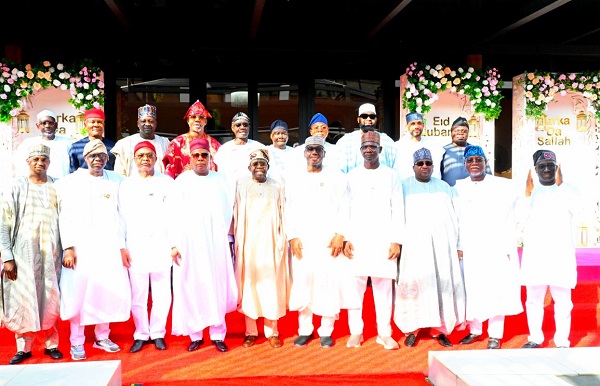
Speaking at a Sallah celebration and third anniversary meeting with state governors, the President claimed that despite its agony, the contentious program was required to save the nation from fiscal collapse and reestablish economic stability.
The deputy governors of Borno and Kano states, as well as the governors of Lagos, Nasarawa, Jigawa, Sokoto, Kebbi, Taraba, Niger, Ekiti, Delta, Ondo, Edo, Adamawa, Benue, Enugu, Ogun, and Kogi states, were present.
Tinubu claimed that Nigeria has spent enormous sums of money on an unsustainable subsidy system for years, which benefited a small number of people while denying vital industries much-needed investment.
At the time, it was difficult, but we made it through. We had to deal with accusations and legal action. We made it through them. Nigeria has survived rather than going bankrupt. The economy has bounced back. It is expanding. The President declared, “Agriculture is booming.”
Tinubu pointed out that continued reforms in the areas of infrastructure, agriculture, social investment, foreign exchange management, and fiscal restraint were starting to pay off in the form of increased investor confidence and economic expansion.
Additionally, he praised governors for encouraging Nigerians to put up with the hardships that came with the administration’s reforms.
“I’m relieved that governors are no longer borrowing money from the federal government, requesting interventions, and struggling to make ends meet or pay their salaries. You preserved hope and the spirit. The advantages are evident today,” he said.
The President noted that gains were being seen in the housing and agricultural sectors, as well as in road construction and repair projects across the country.
“If we use the land in your possession and in your various states effectively, we will achieve food sovereignty,” he declared.
Nigerians were reassured by Tinubu that his administration will keep enacting people-oriented policies that would lessen hardship, increase employment, improve food security, and foster inclusive growth.
Tinubu’s bravery in eliminating the subsidy and taking on powerful oil industry interests was commended by Vice President Kashim Shettima.
“You did not rise to prominence during an easy time. When you arrived, the house needed more than just a carpenter. It took a builder who had the guts to look at the foundation you inherited, according to Shettima.
Instead of calling the reforms “a picnic for the chicken-hearted,” he called them a “battlefield,” adding that the President had made the decision to address long-standing inconsistencies that were impeding the nation’s progress.
Abdulrahman Abdulrazaq, the governor of Kwara State, spoke on behalf of the Nigeria Governors’ Forum and stated that the elimination of fuel subsidies and fiscal reforms had greatly increased states’ financial capability.
He said that many governments could immediately reduce debt, pay off salary and pension arrears, and start important social and infrastructure investment initiatives.
“I think the country was shocked by Mr. President’s audacity to implement that serious policy, but it has greatly benefited from it today,” Abdulrazaq stated.
He stated that the national minimum wage would eventually go to N100,000 and said that several states were no longer need to issue bonds or take on significant debt in order to fulfill responsibilities.
Hope Uzodinma, the governor of Imo State and the chair of the Progressive Governors Forum, also praised Tinubu for his audacious measures that stabilized the economy.
Uzodinma stated, “You have virtually recovered Nigeria from the brink of collapse to a state of stability and survival,” adding that the President received a “100 percent” rating from the governors who evaluated his performance.
Babajide Sanwo-Olu, the governor of Lagos State, had previously welcomed his colleagues to Lagos and expressed gratitude for their ongoing support of the President and his administration.